

By Dhammike Wimalaratne
Sri Lanka is at a pivotal moment in its power sector. The ongoing reform of the Ceylon Electricity Board (CEB) and the transition to successor companies is more than an organizational redesign on paper.
It is a rare opportunity to strengthen how the electricity industry attracts talent, retains experience, and delivers reliable service to the public for years to come.
As a professional engineer who has served in the CEB for more than 18 years, I have seen that the organization’s greatest strength has always been its people—engineers, technical officers, operators, technicians, and many others—working with commitment, often under pressure, to keep the system running. For that reason, I believe the long-term success of the successor companies will depend not only on legal frameworks and new organizational charts, but on whether we adopt a modern workforce approach that matches today’s realities and tomorrow’s expectations.
One workforce idea I introduced publicly in 2022, while serving as the Secretary of the CEB Engineers’ Union, is the 1-2-3 concept. At the time, it may have sounded ambitious. Today, as reforms progress and experienced staff increasingly pursue opportunities elsewhere, it feels more relevant than ever—because parts of this reality are already emerging informally.
The key question now is whether we adopt the concept deliberately and fairly, supported by good systems, or whether we allow it to develop gradually without a clear plan.Why workforce strategy is central to reformDuring any large-scale restructuring, uncertainty is natural.
Employees and stakeholders look for signals: Will the new entities feel more modern and performance-oriented? Will career development improve? Will accountability and decision-making become clearer? Will professional contributions be recognized in a way that encourages people to stay and grow?For the successor companies, these are not merely “HR questions.” They are essential operational questions. Electricity is a 24/7 service. Reliability, safety, maintenance discipline, engineering judgment, and timely decision-making are built on human capability.
A strong workforce strategy is therefore one of the most practical ways to protect performance and build public confidence during the transition.
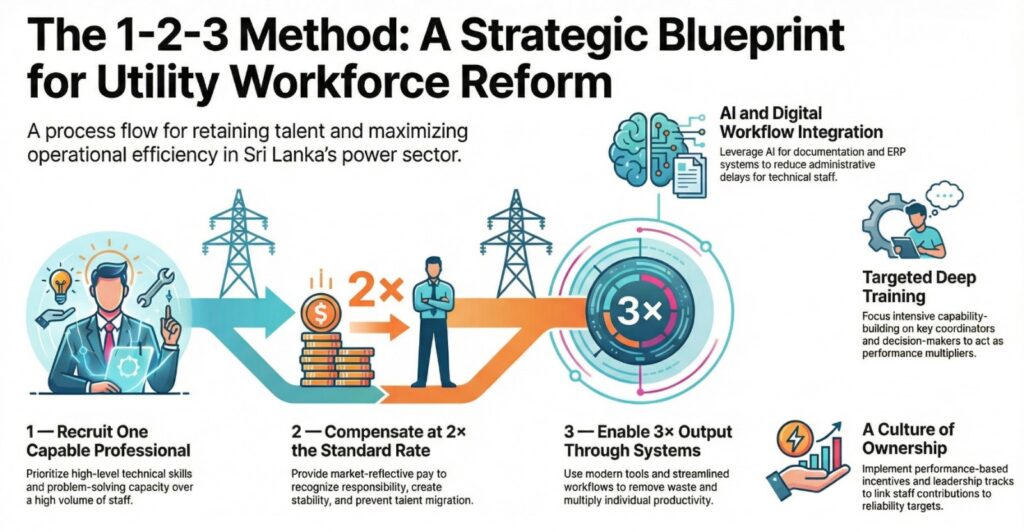
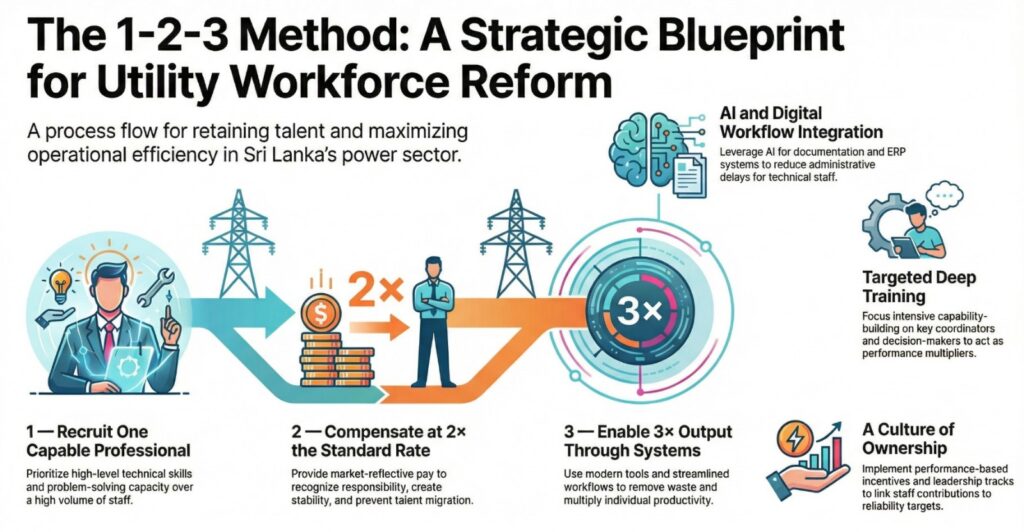
The 1-2-3 concept — explained simplyThe concept is straightforward and universally applicable:1 — Recruit one capable, qualified professionalSelect individuals with strong technical skills, problem-solving ability, and the capacity to grow. Quality over quantity.2 — Compensate at 2× the standard ratePay appropriately to reflect market conditions, responsibility, and the value this professional brings. Fair compensation demonstrates respect and creates stability.3 — Enable 3× output through systems and toolsProvide modern technology, streamlined workflows, training, mentorship, and clear accountability structures.
Remove obstacles so professionals can focus on high-value work.In other words: The 1-2-3 method means paying one engineer at the level of two, while providing the systems, tools, and training needed to deliver output equal to three.
This is not a call to overwork people. It is an invitation to redesign work so that fewer professionals can deliver more—because waste is removed, processes are improved, responsibilities are clearer, and staff are equipped with the right tools and support.
CEB’s current reality: multi-role work is already happeningIn practice, the CEB’s transition period has already created a situation familiar to many technical divisions: one engineer covering two or even three roles.
This tends to happen when experienced staff leave, vacancies remain, and the workload stays constant—or increases.In a power utility, expanded responsibility can include:
• operations support and decision coordination,
• maintenance planning and troubleshooting,
• technical reporting and incident analysis,
• procurement documentation and contract follow-ups,
• vendor engagement, inspections, and quality follow-up,
• compliance, safety coordination, and stakeholder communication.
This multi-role reality is not a complaint; it is an observation—and it also reflects the professionalism of teams who continue to carry responsibilities during a transition. At the same time, it sends a clear message for successor companies: when one person is expected to deliver the work of several roles, the organization should redesign workflows and compensation to reflect that responsibility, so performance remains sustainable and safe.
Retaining engineers is also retaining capability and leadershipEngineers do not leave because they stop loving engineering or lose connection to their country. Many leave because they seek an environment where responsibility is matched by recognition, growth opportunities, professional development, and fair compensation.
The impact of losing experienced engineers is wider than vacant positions. Engineers form part of the analytical leadership pipeline of a country. When they leave, predictable gaps can emerge across the ecosystem—operations, safety management, planning, procurement quality, project delivery, and technical governance.
In a power sector context, those gaps can influence reliability, response time, and service quality.That is why improved pay under the 1-2-3 concept is not “extra.” It can be a rational investment. One capable, empowered engineer can reduce repeat work, improve decision speed, raise documentation quality, and prevent costly avoidable failures—creating value that often exceeds the salary difference.Reform-era advantage: AI tools, modern workflows, and strong core systems
What makes the 1-2-3 concept more achievable today is the rapid maturity of AI tools and modern digital workflows.
With the right training, governance, and templates, these tools can significantly reduce time spent on repetitive professional tasks.
For example, when good templates and review steps are in place:
• reports and summaries can be drafted quickly and refined,
• structured documents can be produced faster and more consistently,
• presentations can be created in minutes rather than days,
• repetitive administrative tasks can be reduced,
• standard procedures and knowledge transfer can be documented more efficiently.
The goal is not to replace engineering judgment. The goal is to remove avoidable delays and raise consistency—so professionals can focus on analysis, reliability, risk, safety, and sound decision-making. For example, a good ERP system for successor companies is essential to standardize workflows and reduce avoidable delays.
When core systems are strong, professionals spend less time searching for information and more time making decisions that improve performance.
Targeted capability-building: train fewer, enable more practical approach for successor companies is targeted capability-building.
Rather than training everyone lightly, identify key groups and train them deeply—particularly those who act as coordinators, reviewers, planners, and decision support.
Even training one-third of key professionals in modern workflows, templates, and AI-supported documentation can lift performance across departments—because trained staff become multipliers for speed and quality. Over time, this approach is often more cost-effective than older training models.
Building confidence through culture Structural reform is important, but employees will also look for a professional culture they can trust.
Successor companies have an opportunity to build confidence by strengthening:
• clear job design and role accountability,
• modern HR practices and career pathways,
• performance-based recognition systems,
• leadership approaches that welcome varied industry experience and modern practices,
• workplace culture that respects professionals and supports growth.
This does not require criticism of the past. It is simply a recognition that a new organizational phase can also become a new professional experience—especially for teams that will be expected to deliver higher output with fewer resources.Belonging and shared outcomesA modern organization also needs to signal that employees belong.
Beyond salary, people stay where they feel respected, developed, and connected to outcomes.Successor companies can explore mechanisms that link staff contributions to organizational performance, such as:
• transparent performance incentives tied to reliability and safety targets,
• recognition systems and leadership tracks,
• career development and certification support,
• where appropriate, profit-sharing or ownership-linked mechanisms that create a sense of partnership.
When employees feel “this is our organization,” accountability strengthens and retention improves naturally.Finally — a model beyond CEBAlthough, I write in the context of CEB’s reform, the 1-2-3 concept is not limited to one institution.
It can apply to any sector where Sri Lanka must protect professional capability—utilities, infrastructure, manufacturing, engineering services, and other technical fields.The core idea is universal: value capable people properly, equip them with modern tools and training, and design work so high performance is realistic and sustainable.
CEB’s successor companies have a rare opportunity to demonstrate what modern workforce reform can look like in Sri Lanka—efficient, professional, future-ready, and fair. If we use this moment well, the benefits can go far beyond one organization, setting a standard for how Sri Lanka retains talent while delivering stronger public services.
** Dhammike Wimalartne is an International Professional Engineer from the Institution of Engineers, Sri Lanka | National Level Advisory Committee Member, National Society of Professional Engineers – USA **


